
Belief OS™ Primer
I first published this model on my Substack, Liftoff with Caroline, in December 2025, following months of analysing a pattern around beliefs that I saw emerging in my 1:1 coaching. I’m currently conducting an ongoing piece of qualitative research to support the writing of my book, Beliefocracy: How our beliefs govern us, which is due to be published early 2027.
What is Belief OS™?
Belief OS™ is a framework that maps how beliefs form, persist, and govern behaviour across multiple levels of human systems. It explains why beliefs are so resistant to change by revealing that they are not simply held in individual minds — they are actively maintained by structures and systems external to the person. This is why mindset work alone does not produce lasting change: you can shift what someone thinks, but if the surrounding system continues to reinforce the old belief, it will reassert itself.
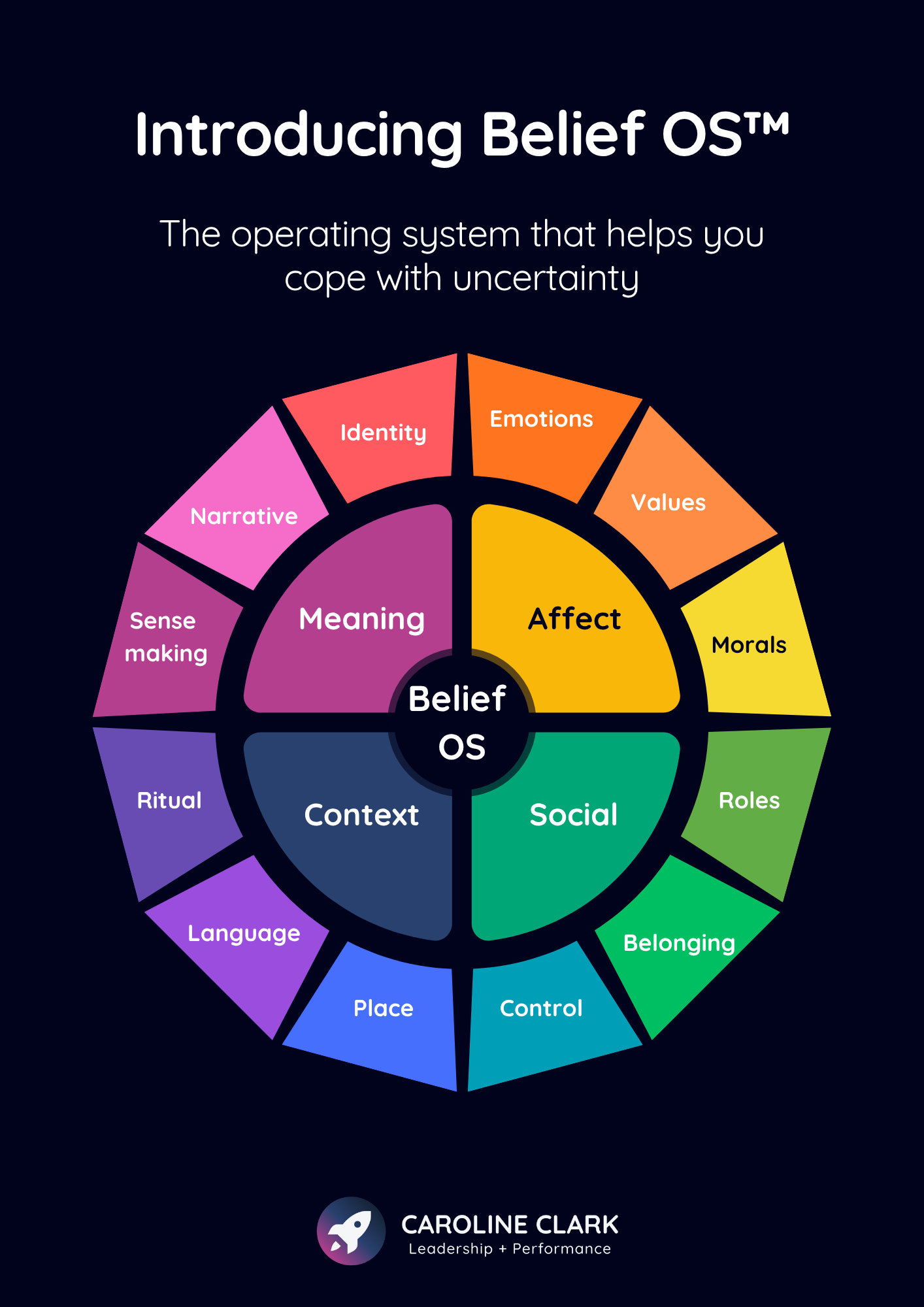
The Belief OS™ Model
The four levers
Belief OS™ identifies four levers that generate and sustain beliefs. Each lever operates through three scaffolds — the external structures that hold beliefs in place. To change a belief, you must examine and intervene at the level of its scaffolds, not just the belief itself.
Meaning
Meaning is the lever through which we make sense of experience. It determines what events signify to us, and therefore what beliefs they reinforce or challenge.
Identity shapes which beliefs feel personally relevant. When a belief becomes part of who someone understands themselves to be, it becomes far harder to dislodge.
Narrative provides the storyline that makes beliefs coherent over time. We construct accounts of our experience that confirm and reinforce what we already believe, filtering out contradictory information.
Sense-making is the active process of interpreting new information through the lens of existing beliefs. It determines whether new evidence updates a belief or gets absorbed into it.
Affect
Affect is the lever through which beliefs acquire emotional and physiological charge. Beliefs that carry strong feelings are more resistant to change than those held purely as intellectual ideas.
Emotions attach visceral weight to beliefs, producing physiological responses in the body that make thoughts feel true regardless of evidence. A racing heart or a knot in the stomach can make an unfounded belief feel as real as a fact.
Values signal what is important to us. They determine which beliefs are treated as non-negotiable, and which are open to revision.
Morals frame beliefs in terms of right and wrong, raising the stakes of questioning them. When a belief carries moral weight, challenging it feels not just incorrect but transgressive.
Social
Social is the lever through which beliefs are shared, reinforced, and policed within groups. Beliefs are rarely private — they are co-constructed and maintained through relationships and group dynamics.
Roles define what a person is expected to believe by virtue of their position. A CEO, a doctor, a parent — each role carries implicit beliefs about what is appropriate, possible, and true.
Belonging creates pressure to align with the group's beliefs in order to maintain acceptance. The threat of exclusion is one of the most powerful forces sustaining beliefs that individuals might otherwise question.
Control determines who has the power to define, challenge, or enforce beliefs within a system. This includes formal authority, but also the incentive structures that reward alignment with particular beliefs and penalise deviation from them.
Context
Context is the lever through which environments make certain beliefs feel natural or inevitable. The physical, linguistic, and ritualistic surroundings in which we operate quietly reinforce what we take to be true.
Ritual embeds beliefs in repeated practice, making them habitual rather than conscious. When something is done the same way every time, the beliefs underpinning it become invisible.
Language scaffolds beliefs through the words and metaphors available to us, shaping what is thinkable. The difference between "I'm redundant" and "my role was made redundant" is the difference between a belief about identity and a belief about circumstance.
Place anchors beliefs in physical environments, so that certain settings trigger certain ways of thinking. A boardroom, a church, a classroom — each space carries implicit expectations about what is believable within it.
Multiple levels
Beliefs operate across multiple levels of abstraction: individual, team, organisation, and society. It is important to note that only individuals hold beliefs in a literal sense. At group levels — teams, organisations, societies — it is the dominant beliefs that emerge as a property of the group as a whole, shaped by the collective interaction of individual beliefs within that system.
These levels interact, and friction arises when beliefs at one level conflict with beliefs at another — for example, when an individual believes in autonomy but the dominant beliefs of the organisation enforce compliance. Lasting change requires understanding which level the belief operates at, and where the inter-level tensions lie.
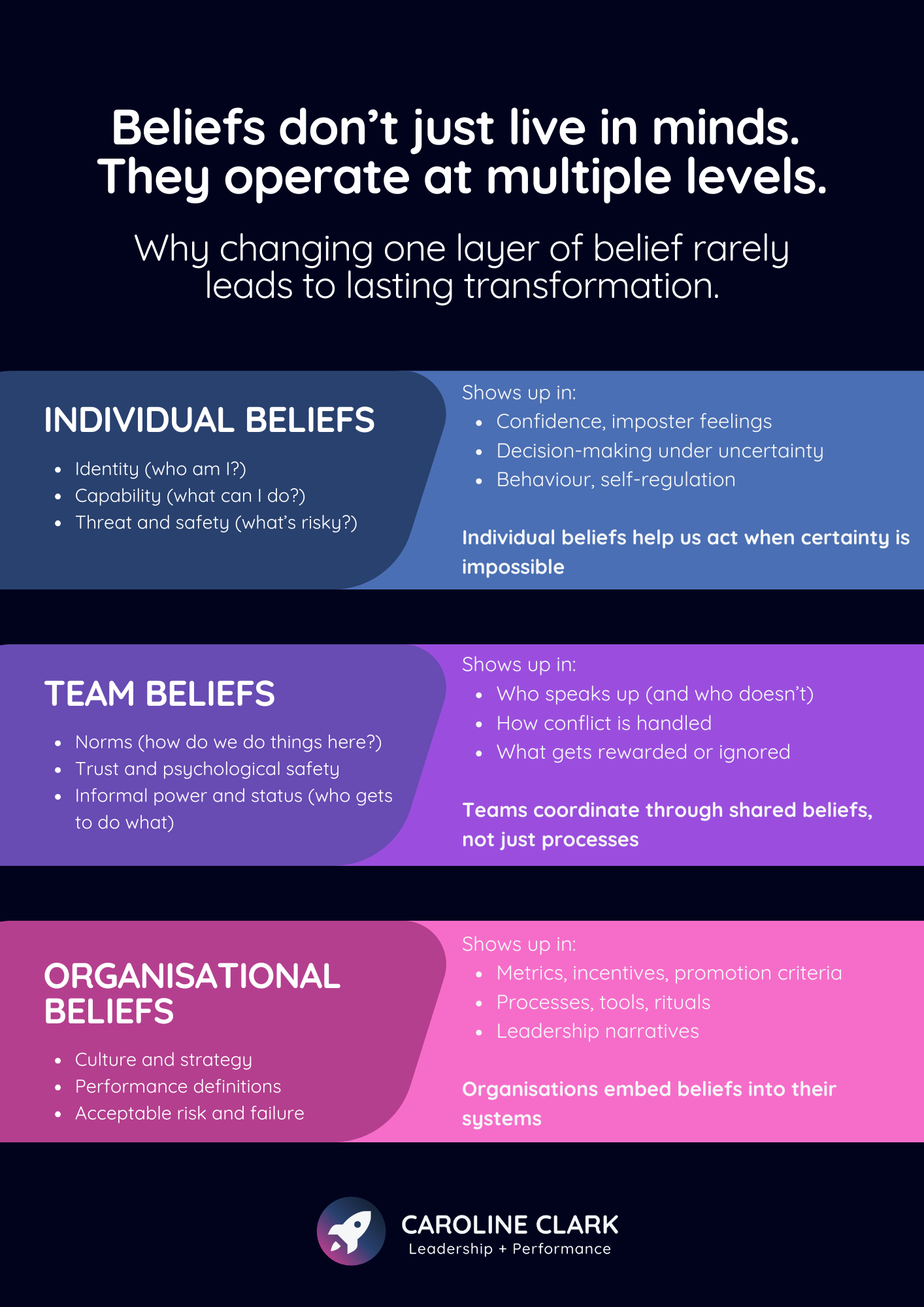
The three levels that beliefs operate at.
The Belief Change Cycle
The Belief Change Cycle is the four-step iterative process for intervening in beliefs using the Belief OS™ framework. Belief change is rarely a one-pass exercise — it requires repeated cycles as beliefs reassert themselves through their scaffolds.
Map
Map the current belief using Belief OS™. Identify which levers and scaffolds are sustaining it. This step makes visible the system that holds the belief in place, rather than treating the belief as a standalone thought to be corrected.
Challenge
Challenge the belief using evidence. The goal is not to argue the person out of their belief, but to sow the seed of doubt — to help them see that the belief might not be true. This creates the opening for change that the next step can act on.
Replace
Replace the old belief with a new one, and then restructure the scaffolds to support it. A new belief cannot survive if the surrounding scaffolds — the language, roles, rituals, narratives — still reinforce the old one.
Sustain
Sustain the new belief by recognising that some beliefs take longer to change than others and must be iterated on. The Belief Change Cycle is not linear — it is a cycle precisely because returning to earlier steps is expected, not a sign of failure.